All content © Robert Williamson

All content © Robert Williamson

Sunday, August 21, 2011

BEN LOMOND SUMMIT (9,712 FEET)

Just as we (my wife and  me) reached the summit of Ben Lomond and looked out over the valley floor of Ogden City and her surrounding cities, we were buzzed by a single engine plane. We waved at its occupants. They took the easy way to the peak. We hiked in 8.2 miles from the trail head at North Ogden Pass. From the peak we were able to see mountains in Nevada to the west, Cache Valley (Logan area) to the North, Ogden Valley (Huntsville, Pineview Reservoir) to the southeast, and most of the cities along the Wasatch Front to the South. There was several large patches of snow at the peak area, a surprise for a hot, late August day.
Ben Lomond Peak.

The wildflowers along the trail and on the ridges and meadows were vibrant and plentiful. I want to get better at identifying wildflowers. After checking with a book, I'm sure we saw, Sticky Geranium, False Lupine, Lodgepole Lupine, Indian Paintbrush, Mountain Bluebell, Showy Daisy, and Kinnikinnick to name a few. I noticed a few different varieties of evergreen trees. I'm not an expert but I think I identified Douglas Fir and Bristlecone pine.
Indian Paintbrush.
The trail was lined with wildflowers.
One group of evergreen was fascinating to me. The hill they were growing on was somewhat steep. The trail cut through them and the shade and coolness in the air was a pleasant relief from the sun. Almost every trunk on these trees looked like it started to grow out of the slope and then suddenly decided to bend skyward. This created a bend in the base of the trunk. These were stout trees. Most of the hillside was hard and rocky. The roots of some of the trees looked to be growing out of the rock. As I examined the roots I could see where they were intermingled in the rock and soil. I imagine they ran deep beyond the exposed rock and soil to support their weird bends and reach the thirty and forty foot height.
Along the ridge. Ben Lomond in far background.
A mix of colorful wildflowers.
After coming out of the small grove of pines we hit two long switchbacks through thick brush with an almost imperceivable gradient. The end of the last long switchback brought us to the top of the main ridgeline leading to the summit. The summit was now visible in the distance as well as a nice view of the valley floor below. We paused at this spot and took in the vistas. Just to this point was worth the hike but our goal was to make the summit so we started along the west facing trail just below the ridge.
At the summit looking south to Mount Ogden.
We had heard that a herd of mountain goats roamed the rocky cliffs of Ben Lomond so I had my eyes peeled. I had never seen a mountain goat in real life. Seeing one would be a first. We stopped at a rock outcropping to snack and hydrate. A couple of hikers caught us and after exchanging greetings they told us they had seen a couple of goats down the trail. The news of the goats got me looking with more effort. As we came to the next area of trail where I could look down into the high meadows and rocky cliffs, I spotted a couple of the goats. They glowed with whiteness against the gray rocks and green brush. Further up the trail some other hikers had climbed up some rocks and were talking about a group of goats they could see. I climbed up the rocks and looked over the edge. A group of about twenty goats were nervously moving along the hillside. They finally dropped down into the rocks on the cliff and disappeared. I knew these goats could climb and run in some rough terrain, but watching them climb around the steep rock face of Ben Lomond's cliffs left me amazed.
Ben Lomond Peak as viewed from the valley floor.

Heading up through the pines.
Bright yellow wildflowers.
Rocky switchback trail leading to the summit.
Gorgeous gal at trail sign.
9,712 feet.
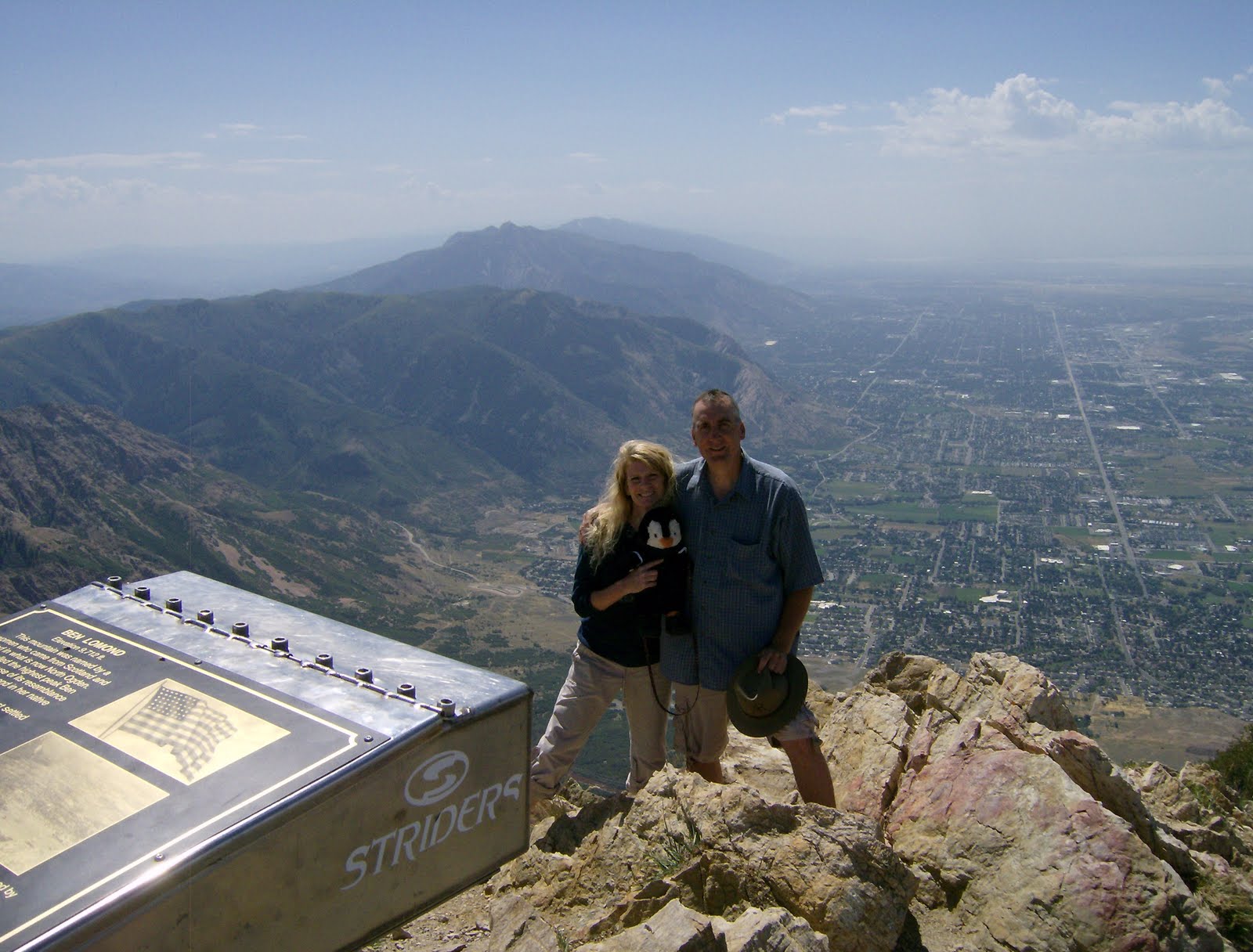
Summit sign-in box. North Ogden below.
Looking North from summit. Cache Valley in the distance.
August 20, 2011. Snow at Ben Lomond Summit.
Beautiful Vistas.
Gun display and destination summit in background.
Most of the mountain ridges were covered in wildflowers.

Willard Peak in background.
Looking south along the Wasatch Front toward Salt Lake City.

Tuesday, August 9, 2011

ROY DAYS 5K and UPCOMING EVENTS

Had a blast running the Roy Days 5K Saturday the 6th of August. It was a tough little run. I haven't kept up on my training this year and knew going into the run that I would be a little slow and sucking some wind. I ran with my bro-in-law, Mark. There was 119 men runners and about 300 runners overall. Mark and I placed 53rd and 54th overall, which isn't too bad for a couple of "older" gentlemen. Our time of 26.21 was off a bit but something we can work on. Our next adventure is a 17 mile mountain bike ride from Logan Canyon to Bear lake.

My wife and I have a hike planned to reach the summit of Ben Lomond (North Ogden Peak) in a couple of weeks. We are trying to be at the summit at dark so we can watch the Perseid meteor shower from the top. We will then hike out in the darkness. Stay tuned for a detailed report.

Fly fishing? I have not been in a position to get out like normal. Hopefully, that will change. My favorite time to be on stream is fast approaching. School will start soon and all the kids and campers will be out of the mountains for the most part---then it's prime time for me.

Saturday, July 23, 2011

PERFECT JEWELS

Lately, it seems, everything is coming in "small". I had a small window of opportunity to sneak out on a small creek in search of small native cutthroat trout. Even though it was only a two hour adventure, it was much needed.

My wife loves to go on these little outings. They usually involve a short hike or stroll through the woods. We try to identify wildflowers and trees. We look for sign of animals. Most importantly, we look for the places trout hide.

As we turned the corner on the trail, the sound of the creek became more noticeable. It is such a pleasant sound and brings a calm feeling over us. It feels as if my ears are like lungs and inhale the trickling, bubbling, and cascading rhythms of moving water. These small creeks have a different sound than the larger rivers. To me it is inviting. It's more of a whisper, "Here, come sit and visit with me." The larger rivers call out with power and authority, "I'm mighty and powerful and if you don't respect me, I'll kill you!" Both have a pull on my spirit, but the soft tones of the creeks have my heart.
SMALL BEAUTIFUL JEWEL
HITTING SMALL POCKET WATER
I consider the small native cutthroat in these creeks as jewels. One of the definitions of a jewel is: a precious person or thing. The small trout fit this definition for me. A jewel is also described as a treasure, a gem, marvel, find, godsend, prize, blessing, and masterpiece. There is no question I could find a way to explain the trout in any of the aforementioned ways.
LITTLE CREEKS ARE
 NICE PLACES TO SPEND A COUPLE OF HOURS
To explain the pursuit of the trout (and the experience of each outing as a whole), I would use the word "perfect", although most fly fishermen will tell you that all things concerning fly fishing are far from perfect. Yet, I find upon reflection, when afield, and as I smile to myself as I reminisce in moments of quiet ponder, that what I feel is a form of perfection--not that it is a reflection on me as a person, but rather, a reflection of the environments where fly fishing takes me, and an inner peace I find in those environments. In its way, that peace comes home with me--eventually runs out, and then needs recharged with another outing.  In Norman Maclean's book, "A River Runs Through It" he mentions this perfection. "So on this wonderful afternoon when all things came together it took me one cast, one fish, and some reluctantly accepted advice to attain perfection." He goes on, "When I was young, a teacher had forbidden me to say "more perfect" because she said if a thing is perfect it can't be more so. But by now I had seen enough of life to have regained my confidence in it."

I tend to believe in what Maclean writes. When I get the chance to spend time in the places I love, doing the thing I love (fly fishing), either alone or with the person I love most--I don't know of anything "more perfect".

HIGH AS A KITE


The summit of Frary Peak (Antelope Island). We flew a kite to symbolize that even when we reach a goal or summit, there is often a way to go higher!

On the trail. Frary Peak behind us.

Indian Paintbrush


The marker at the summit.

Wasatch Front and Great Salt Lake in the background.


More wildflowers and gnat bites on the legs. Ouch!


One of the islands famous residents.


Hot babe wading. Fremont Island in background.


Goofing around. Elephant Head in background.
 I guess I better explain the penguin (for those who are unfamiliar with why we carry it with us). Our son is on a  two year mission for the Church of Jesus Christ of Latter Day Saints. He is in Georgia and Florida. His favorite animal is the penguin. We take the penguin on our adventures as if we were taking him (yes, we miss him). We then share the pictures with him.  Flying the kite from the summit was to let him know that he (and all of us) can reach goals and then extend just a little higher.

Saturday, May 14, 2011

Evening Hike

We climbed the switchbacks until we were up to the Bonneville shoreline trail, then dropped down into the canyon where the small creek swelled with snowmelt. After 20 days of almost nonstop rain, it was good to be out. We were on a quick evening hike to see the lower falls in Adam's Canyon. As we neared the creek, we could hear the water as it plunged over the fifteen foot falls. It's not a spectacular site, but with the runoff it is a little more dramatic than normal. The water was just a bit off-color, similar to the look of packaged hot chocolate with too much water added to it. The sound of the crashing water was constant applause.

This hike is not a long hike but the switchbacks are nice for a quick workout. The cold spring weather and the coolness of the evening air made the mist coming off the falls feel chill. Getting totally wet was not an option on this hike. On a hot summer day, standing under the falls, or at least close enough to get the cool mist would be a welcome relief.

Last year we hiked up Adam's Canyon to the upper falls. I wondered what the upper falls would be like this year with a much higher volume of water pouring out of the mountains. It's probably worth the effort. I also heard a story about some type of cabin above the upper falls. From what I've heard, it's an older structure. I'm not sure who built it or why it would be in such a remote and rugged area. The cabin whereabouts and history would make a good research project.

We hiked down before the sun was fully set. Clouds on the western horizon hid the sun from view. Gaps in the cloud cover provided streaks of blue, gray and silver illumination down on the Great Salt Lake, Fremont Island, and the Promontory mountains. I always get giddy satisfaction when I see beauty and when I feel a sense of accomplishment, even when that accomplishment is something as simple as a hike. I've always been satisfied to live in the Great Basin and along the Wasatch Front. Everything I've come to love is near. I am humbled and honored to call this place home.

Tuesday, April 19, 2011

Meniere's Disease and Exercise

I was diagnosed with Meniere's disease 26 years ago. It can't be cured and doctors struggle with what causes it and with solutions to prevent it and even remedy it's severity. Meniere's disease affects the inner ear. Symptoms vary with individuals but most have a fullness feeling in the ear, tinnitus (constant ringing), clicking, dizziness, hearing loss, and drop attacks. I have gone through periods of each symptom. The worst has been the drop attacks. A drop attack is when the world turns upside down very fast. The sensation is one of falling quickly to the ground and that is exactly where you find yourself. Because these attacks happen so swiftly, it is often difficult for people with Meniere's to work in jobs where they are on ladders or high places with the chance of falling. If the attacks come regularly, it would be difficult and scary to drive a car. Luckily for most sufferers, the drop attacks are infrequent. I've had about six such attacks in the last 26 years, two while driving a car. Both times I have had my wife take the steering wheel from the passengers side until the major portion of the attack is gone. This usually only lasts several seconds, but the spinning sensation can last for hours and sometimes days.

My early struggles with this disease were difficult. It is a hard disease to diagnose and all other possible problems need to be ruled out. I had to go to specialists and had to rule out damage to the ear drum and a tumor. Once I was cleared of those two things, I spent years trying to maintain my hearing and remedy the fullness and dizziness. As is common with most sufferers, nothing has worked. I have had to learn to just live with it. I have had good years and bad years. Sometimes the symptoms will last for weeks and sometimes just a few days. I have been trying to understand what might trigger the episodes and attacks. Most of my struggles come with changes in barometric pressure from storms, stress, allergies, too much salt, and not enough rest.

The worst part for me has been the dizziness. I've been able live with the hearing loss, the feeling of fullness, and constant ringing. I'm not sure those who try to talk to me or whisper in my left ear appreciate having to repeat things, but I'm able to live with that part. The doctors tell me that with each attack, I will lose more hearing. Hearing test indicate that I have already lost my ability to hear certain higher tones. When I'm suffering an attack it is estimated that about 80 percent of my hearing in the left ear is gone. When not suffering the estimate is around 40 to 60 percent loss.

Why am I telling you all of this? The last few years I have been trying to stay in better shape. I have been running, riding a bike, hiking, and walking a lot more. Last year I felt really good. My theory is this: as we age and get sedentary, it can affect our bodies in adverse ways. I think the exercise has flushed my body of salt retention, provided better blood circulation, increased metabolism, and helped with oxygen and lung capacity. Last year as I pushed myself, I did not have Meniere's attacks or severe symptoms as bad as years past.

This past winter I didn't stay on my schedule like I wanted. I enjoyed the holidays and told myself that I could get with it when spring arrived. Well, spring has been taking its sweet time getting here and I find myself suffering from an episode of Meniere's. It will be interesting to see how it responds to the physical activity. Can I run it out of my system? Did the physical activity of the last two years really help with the symptoms? I'll be finding out.